The Old City on Foot: Three Temples, and Who Charges What
Updated September 30, 2026 · 7 min read
The old city was laid out in 1296 as the fortified capital of the Lanna kingdom, and the moat still runs unbroken around all four sides. Everything in this article sits inside that square. You can walk the whole of it in a morning, which is the first thing worth knowing – and the second is that the three temples everyone visits are close enough together that the walk between them is shorter than the queue for a songthaew.
Our inventory holds 127 temple offers for this city, from €10.30, with 39,712 reviews. The narrower category of guided city walks and rides is much smaller: 37 offers from €10.91, with 3,740 reviews between them. That gap is the whole story of this page. Nearly everything sold as a Chiang Mai temple tour drives you out of town to Doi Suthep. What stays inside the walls is cheap, short and comparatively unbooked.
The walk itself
The 3-Hour Old City and Temples Guided Walking Tour – €10.91, 4.6 stars, 1,704 reviews – is the most-booked of them, and at that price it is among the cheapest guided anything in our inventory. It covers three temples: Wat Chedi Luang, Wat Phan Tao and Wat Phra Singh. Three hours for three temples sounds slow until you have stood in front of the first one.
There is a second, less-booked option in the same shape: the Historic Temples and City Guided Walking Tour with 773 reviews. Both do on foot what the evening and sunrise tours do by van, and the difference is not the temples but the pace.
The broken one
Wat Chedi Luang is the reason to come, and it is a ruin. Construction began under King Saen Muang Ma between 1385 and 1402, stopped after about ten years unfinished, and was completed in the middle of the fifteenth century. At that point it was the tallest building in the Lanna kingdom – sources give the height as 80 metres or 82 metres, and nobody measured it after what happened next.
In 1545 an earthquake took off the upper thirty metres. It was never rebuilt to its original height, and the squared-off stump you see today, with its brick flanks and its restored elephant reliefs, is what the earthquake left. That is unusual and worth sitting with: most famous temples in Thailand are gilded and finished, and this one is deliberately not.
The Emerald Buddha – the image now in Bangkok – was installed in a niche on the eastern side in 1468. It left in 1551. Where it went in between is told differently depending on who is telling it: some accounts move it straight on to Luang Prabang, others have it spending roughly a decade at Wat Phra Singh, two streets away, after the earthquake. Both versions are in circulation and we could not settle which is right, so take the tour guide’s version as one of several.
The other two
Wat Phan Tao stands on the same block as Wat Chedi Luang, is much smaller, and is built of teak. It is a five-minute stop and the operator prices it at 20 THB. Most people photograph it and move on, which is a reasonable thing to do.
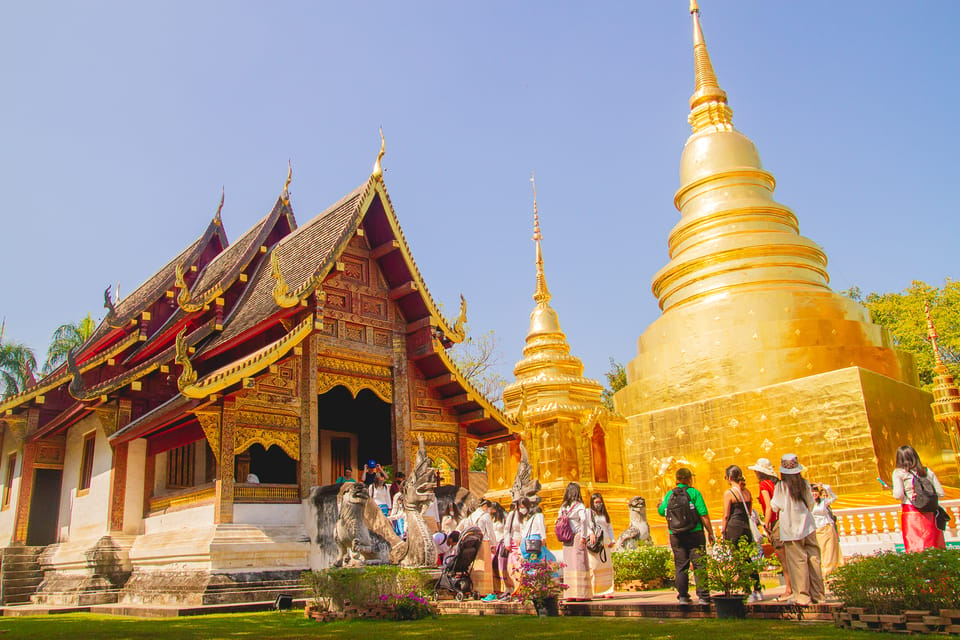
Wat Phra Singh is the busy one, at the far end of the main street through the square. It was built in 1345 by King Pha Yu, for the ashes of his father, King Kham Fu – so it is older than the broken chedi, and it looks it least, because it is the best maintained of the three. If the picture at the top of this page looks like the postcard version of a Thai temple, that is Wat Phra Singh doing what it does.
The fees, and why every source gives you a different number
This is the part that is genuinely confusing, and we would rather show you the disagreement than pretend it away.
The operator of the walking tour above lists the entrance fees on its own booking page but marks all three as not included – Wat Chedi Luang 50 THB, Wat Phan Tao 20 THB, Wat Phra Singh 50 THB. Independent guides published this year give 40 THB for Wat Chedi Luang, with under-12s free, and put Wat Phra Singh somewhere between 20 and 40 THB for foreign visitors. Opening hours are consistently given as 6 am to 6 pm for both of the large temples.
We cannot tell you which figure you will meet at the gate. What we can tell you is that the spread is small in absolute terms – the entire difference is a few dozen baht – and that carrying two hundred baht in small notes makes the question disappear. If you take the guided walk, the fees come on top of the €10.91: the booking page lists all three entrances, and hotel pick-up, as not included; what the price covers is the guide and the walk.
Dress, and the one rule people get wrong
Shoulders and knees covered, shoes off inside the halls. The booking page states it more strictly than most: clothes revealing your shoulders, underarm, back or knees are not permitted. The detail that catches people out is underarm – a vest top with a wide armhole fails the rule even though the shoulder is technically covered. Wat Phra Singh and Wat Chedi Luang both lend sarongs at the entrance, but you are queueing for one in the heat rather than walking in.
When this is a bad idea
Three hours on foot in the old city between about 11 am and 3 pm is hot work with very little shade, and the temples that give shade are the ones you are supposed to be quiet in. Morning departures exist for a reason.
The same operator lists the walk as not recommended for pregnant travellers or for anyone with mobility impairments, heart problems or respiratory issues, and asks for moderate fitness. That last point matters more in some months than others: from late February into April the northern burning season puts haze over the city, and a three-hour walk outdoors is exactly the activity that becomes unpleasant first. If you are here in March, the best time to visit page explains what you are dealing with in more detail.
What this walk is not
It is not the mountain. Wat Phra That Doi Suthep sits fifteen kilometres away and 1,073 metres up, it is a separate half-day, and it is covered properly in our guide to Doi Suthep and Wat Pha Lat. Any listing that promises you the old city and the mountain in three hours is promising a drive, not a walk.
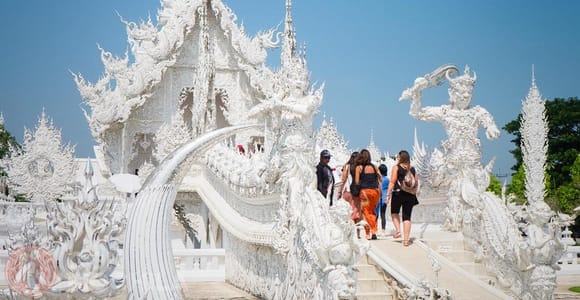
And it is not Chiang Rai. The white, blue and black buildings that fill most Chiang Mai temple listings are a 190-kilometre day trip in the other direction, with its own logic and its own naming muddle – see Chiang Rai in a day.
What the old city gives you instead is the oldest layer, on foot, for the price of lunch. Browse the full range on our temple tours page, or the guided walks and rides on city tours.