Chiang Rai in a Day: There Is No Red Temple, and Other Useful News
Updated September 30, 2026 · 8 min read
The most-booked day trip from Chiang Mai is 190 kilometres each way, sells four coloured temples, and delivers three buildings – one of which is not a temple. That is not a scam. It is a naming muddle that has been copied from listing to listing until nobody can see through it. Untangling it is the most useful thing this page can do for you.
Four colours, three buildings
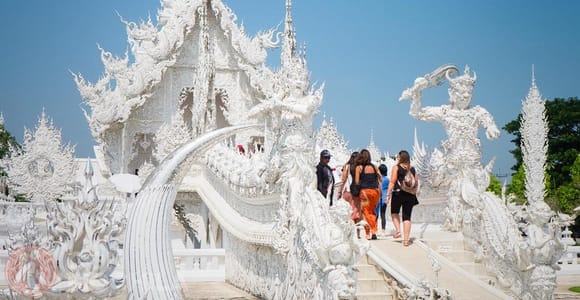
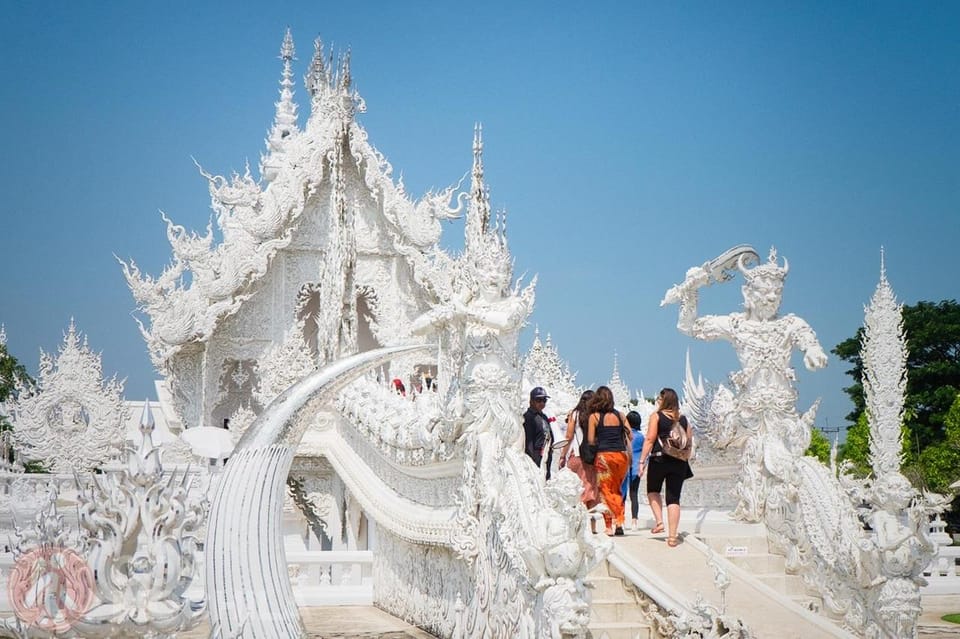
White is Wat Rong Khun, the one everybody comes for: Chalermchai Kositpipat’s mirrored, spiked, deliberately overwhelming temple, opened in 1997, funded from the artist’s own money and still unfinished – the completion date he gave is somewhere around 2070. Open 8 am to 5 pm. The entrance fee for foreign visitors rose from 100 to 200 THB on 1 January 2026. Shoulders and knees covered; sarongs are available.
Blue is Wat Rong Suea Ten, designed by a student of the same artist and finished in 2016. It is a working temple, open roughly 7 am to 8 pm, and generally described as free with donations welcome – although a small fee is mentioned in places, so carry change.
Black is Baan Dam, and this is where the listings mislead. It is not a temple. It is the house and museum complex of the artist Thawan Duchanee, who died in 2014: dark teak halls full of hides, horns and bones. Entry is 80 THB, free for children under 12, open 9 am to 5 pm with an hour’s break at midday. There is no dress code, because there is nothing sacred about it.
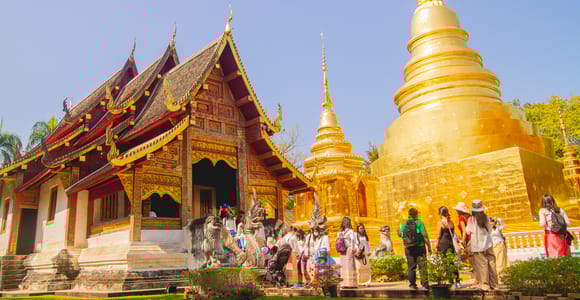
Red is the one that does not exist as a separate building. There is no red counterpart to the white and blue temples. What the tour titles mean is Wat Huay Pla Kang, a hillside complex with red pagoda roofs and an enormous white Guanyin statue you can ride a lift up inside. The grounds are free, the lift is about 40 THB, open 7 am to 9 pm. The statue’s height is given as 80 metres in some sources and 90 in others.
We did not work this out from a guidebook. It is written into the booking pages: one operator sells its day as a choice between a 280 THB package covering Wat Rong Khun, Black House and the White and Blue temples and a 340 THB package covering Wat Rong Khun, Wat Huay Pla Kang and Lalitta Cafe – labelled the “Red White Blue” option. Red and black are alternatives on the same tour, not two stops on it.
So if you want to see both Baan Dam and Wat Huay Pla Kang, one day trip will not do it. That is the single most useful sentence on this page.
(One caution about those two figures: on the page we read, the 280 and 340 THB amounts sat in the same block as the inclusions rather than under a separate heading, so we cannot be certain whether they are supplements or already covered. Check on the live booking page before you count on either.)
What a day costs and what it contains
Our inventory holds 115 day trips from Chiang Mai, from €11.83, median €57.83, with 38,096 reviews. The Chiang Rai runs dominate it.
The most-booked by a distance is Chiang Rai White, Blue & Red Temples & Karen Tribe – €23.39, 4.8 stars, 8,642 reviews, listed at 11 hours and running up to 13.5. Its booking page is refreshingly specific: transport, guide, insurance and an audio guide are in, temple entries are in if you select that option, and explicitly not included are lunch and the 300 THB Long Neck Village entrance fee.
The cheapest full version is White Temple & More, Karen Tribe & Lalitta Cafe at €22.34 with 4,645 reviews, at 12 hours. The White, Red/Black & Blue Temples Tour with Lunch is €27.60 and includes lunch, water and fruit, with pick-up between 7 and 8 am and a stated dress code of covered shoes, covered shoulders and long trousers. It also carries 4.2 stars across 2,210 reviews – the lowest rating of any Chiang Rai day with more than a thousand reviews in our inventory, and the gap to the 4.8 above it is worth a minute of your reading time.
If you want the Golden Triangle as well, Chiang Rai Temples, Golden Triangle & Boat Tour costs €59.93 and runs 15 hours. Sop Ruak is another 70 km beyond Chiang Rai; the boat across to the Lao island of Don Sao takes thirty to forty-five minutes at roughly 400 to 500 THB a head, and needs no visa as long as you stay on the island.
The part of this trip that deserves a hard look
Most of these tours include or offer a “long neck Karen village”, and it is the stop worth deciding about deliberately.
The women are Kayan, also called Padaung – not Karen in the narrow sense. They came to Thailand as refugees from Myanmar from the late 1980s onwards and live in border villages that they largely cannot leave. They do not hold Thai citizenship. Access to electricity, roads, healthcare and schooling is limited, and Thai authorities have declined to resettle them out of the tourism villages on the grounds that they are economic migrants. There are documented cases of women being refused exit papers despite resettlement offers from other countries, with the tourism income given as the reason.
Human rights groups and ethical travel campaigns have used the phrase human zoo about these villages for years. The counter-argument – that the money is what keeps the community fed – is real, and the honest complication is that it is not clear where the 300 THB actually lands. Village heads and site operators are named as the primary recipients in what we could find; residents earn mainly from selling their own crafts. We could not verify that with a source we would want to stand behind.
You do not have to resolve that. But it is a stop you should choose, not one you should discover at 2 pm because it was bundled. Every listing we read treats it as optional or as a paid extra, which means declining it is straightforward.
Nearly seven hours of driving
That is the real cost. The drive is three to nearly four hours each way on Highway 118, and the schedules confirm it: on the most-booked tour, roughly an hour and a half plus two and a quarter hours outbound, and three hours back. You are looking at nearly seven hours in a vehicle for five or six hours on the ground, with arrival at each temple timed to coincide with every other minibus that left Chiang Mai at seven.
Two alternatives. The Greenbus from Arcade Bus Terminal 3 runs thirteen departures between 7 am and 6 pm, from about 260–290 THB for an express seat and 360–400 THB for VIP, arriving at Chiang Rai’s Terminal 1 – which makes an overnight genuinely cheap and puts you at the White Temple at opening time, before the coaches. And if you would rather set your own hours on the way up, it is worth comparing car hire for Chiang Mai, remembering that Thailand drives on the left and that police checks expect an International Driving Permit alongside your own licence.
Lalitta Cafe, which appears on an improbable number of these itineraries, is a garden café with a constructed waterfall and a koi pond near Wat Huay Pla Kang. Entry is around 60 THB for adults and 40 for children; whether that comes off your bill is contested in recent reviews. It is pleasant and it is a photo stop, and it is on the tour because it is next to the red temple that is not called that.
For the rest of the region, see day trips from Chiang Mai and the Lanna culture and crafts inventory. If a long day in a minibus is not what you came for, the temples on Chiang Mai’s own mountain are forty minutes away rather than three hours.