Doi Suthep and Wat Pha Lat: Sunrise, Songthaew or the Monk's Trail
Updated September 30, 2026 · 7 min read
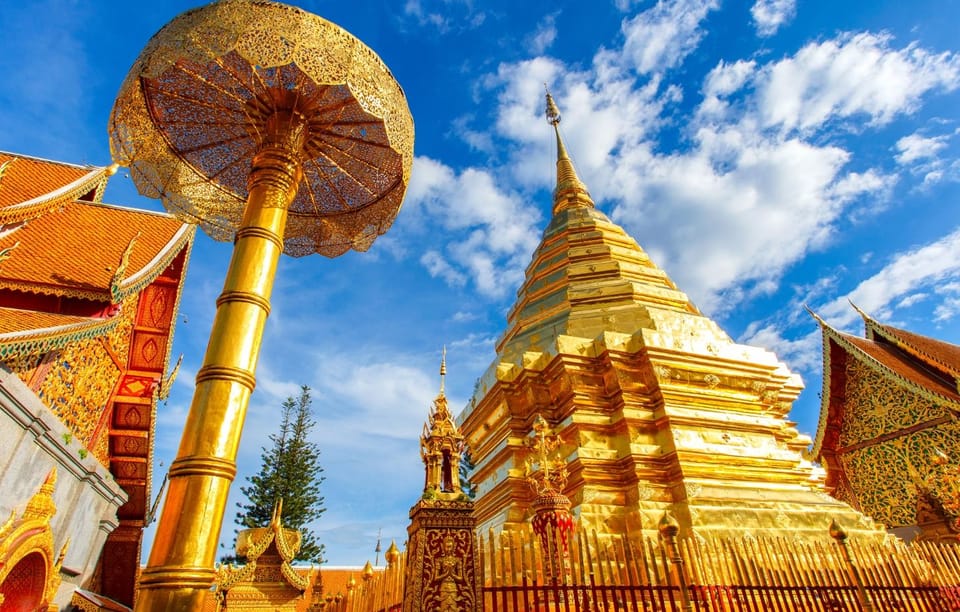
Wat Phra That Doi Suthep sits at 1,073 metres about fifteen kilometres from the old city, and it is the thing most people photograph when they photograph Chiang Mai. The temple dates from 1383, and its founding story is the one every guide tells: a relic was split at Wat Suan Dok in 1368, one half was loaded onto a white elephant, and the elephant walked up the mountain, trumpeted three times and died where the temple now stands.
Our inventory holds 127 temple offers for this city, from €10.30, with 39,712 reviews. Most of them go here. What separates them is how you arrive and at what hour.
The three routes up
The red songthaew is the local answer and the cheapest. They leave from Chang Phuak Gate and from the zoo end of Huay Kaew Road, cost roughly 40 to 50 THB a person each way, and depart when enough passengers have gathered – often around ten. Agree the fare before you get in, and budget for the wait in both directions. The Doi Suthep & Wat Pha Lat by Local Red Truck tour – €15.35, 4.7 stars, 902 reviews, 4 hours – is that same ride with the waiting and the negotiating taken out.
The Monk’s Trail starts at the end of Suthep Road beside gate 1 of Chiang Mai University. It is about two kilometres and thirty to forty minutes up through forest to Wat Pha Lat, marked with strips of orange monk’s robe tied to the trees. Carrying on to the main temple makes it roughly 7.5 km with 620 metres of ascent, about three and a half hours. In the rainy season from June to October the path is washed out and slick, and local advice is not to do it then.
Only a handful of offers in our inventory actually walk it. The most-reviewed is the Doi Suthep Temple & Wat Pha Lat Hike – €21.03, 4.7 stars, 898 reviews, 4 hours; the Monk’s Trail Hike, Wat Pha Lat & Doi Suthep Tour is the cheapest at €10.30 but has only 7 reviews. Rather more listings put “Pha Lat” in the title and drive there. That is not dishonest, but it is a different morning, and the difference is the entire point of Wat Pha Lat: a small, mossy, half-wild temple you reach on foot, which is a very different thing from a stop between two car parks.
Driven, early or late. The Doi Suthep, Wat Umong and Pha Lat Sunrise Tour – €21.16, 4.7 stars, 1,508 reviews, 4 hours – does it at dawn; the Doi Suthep and Wat Umong Enchanting Evening Tour at €19.79 with 1,906 reviews does the same stops at the other end of the day.
The stairs, and how many there are
The naga staircase is the approach, and the step count is quoted as 306 by most guides and as 309 by Wikipedia and by both operator booking pages we read. The difference is almost certainly where you start counting. Either way it is a single flight with a dragon balustrade and no landings worth the name.
There is a funicular for anyone who would rather not. Its fare is given as 20 THB in one place and as 20 THB for Thai visitors against 50 for foreigners in another, and claims that it makes the temple step-free are not backed by anything we could verify. If step-free access is what you need, ask the operator specifically and do not rely on a listing.
The fees, including a new one
Temple entry is where sources part company: most current guides say 30 THB for foreign visitors, while one operator states on its own booking page that it includes the Doi Suthep entry fee (THB 50) along with a Wat Umong entry fee (THB 20). Carry a hundred baht and the question answers itself. Opening hours are generally given as 6 am to 8 pm, with some sources claiming a longer day.
The new one is easier to miss, and it lands on walkers specifically. Since 1 October 2025 Doi Suthep-Pui National Park charges its own entrance fee: 100 THB for foreign adults, 50 THB for children (Thai visitors pay 20 and 10). It is not a temple ticket, and it explicitly does not apply to everyone: reach Wat Phra That Doi Suthep and Wat Pha Lat by the main road and you do not pay it.
Walk the Monk’s Trail, though, and you do. The Pha Lat Nature Trail is named in the fee ruling, alongside Huay Kaew Waterfall, Wang Bua Ban–Pha Ngoap, Doi Pui and Suan Son. That is the practical difference: the same two temples cost you 100 THB more on foot than by road. Bring it in cash.
Dress, and what happens if you get it wrong
Shoulders and knees covered, shoes off inside the shrine. One booking page states the rule the way the temple applies it: no shorts, no short skirts, no sleeveless shirts, and shoulders, armpits, back and knees all covered.
Sarongs are lent at the entrance. Whether that is free or costs around 20 THB depends on which account you read, and on busy mornings the supply reportedly runs out. Bringing a scarf or long trousers is the version of this that does not depend on anyone else.
Sunrise: what it does and does not deliver
Sunrise in Chiang Mai falls at roughly 6:41 am in December, 6:57 am in January and 6:19 am in April. The temple terrace faces east over the city, and the gates open around 6 am – so in the cool months the timing works comfortably. In April it is tighter. No official source we found promises the gates are open at first light, so a tour that sells sunrise is selling its own arrangement with the temple, not a published guarantee.
And what you see depends on the month more than on the hour. Northern Thailand’s burning season runs from late February into late April, peaking in March, and on the bad days the city below simply is not visible. That is also, awkwardly, the tail of the high season.
The most expensive of the well-booked options here is the Spiritual Sunrise: Doi Suthep, Pha Lat, Alms & Meditation – €48.63, 4.9 stars, 848 reviews, 5 hours 30 minutes – and the only one in the whole inventory that puts an alms round and meditation together in the title. Pricier Doi Suthep offers do exist, up to over €100, but they are private trips with single-digit review counts. Its own description says very little about what either actually involves, which for a €48.63 morning is worth asking about before booking rather than after.
On the alms round itself: it happens before sunrise, around 5 am. The etiquette is not complicated – do not touch the monk or the bowl, do not hand things over directly, and money is not what goes in. That is general Thai practice rather than a rule published for Chiang Mai, and if you are joining one, your guide is the person to ask.
Two stops that usually come attached
Wat Umong, at the foot of the mountain, is a forest temple with brick tunnels and a very different atmosphere from anything at the top; most sources call it free with a donation box, one operator lists 20 THB. Bhubing Palace and the Hmong village at Doi Pui sit further up the same road – the palace is 50 THB, open 8:30 am to 4:30 pm and closed when the royal family is in residence, often between January and March. The village charges nothing; its museum is 10 THB.
For the temples in town rather than on the mountain, the Chiang Mai temples page has the full inventory, and the city walking tours cover the old city on foot. If the mountain rather than the temple is what you are after, the Doi Inthanon day trip is a much longer day on a much higher peak.