When to Come to Chiang Mai: The Month Matters More Than the Weather
Updated September 30, 2026 · 8 min read
Most destinations have a best season and a wet one. Chiang Mai has three seasons, and the one that decides your trip is the one nobody puts in the brochure. It is not the rain.
The three seasons, plainly
Cool season, roughly November to February. Daytime temperatures in the range of 15 °C to 28 °C, low rainfall, clear air. This is the season everything is built around, and if you have a free choice this is the answer. It is also the busiest and the most expensive, and the temples in the old city feel it.
Hot and smoky, late February into April. Temperatures climb and the air degrades. This is the season below.
The rains, roughly June to October. Sources put the start at May or June depending on who is counting, and agree that about 85 % of the annual rainfall lands in this stretch, on an annual total of roughly 1,200 mm. The picture people have of this season – constant grey drizzle – is wrong. The picture of a heavy afternoon downpour that stops is closer.
The burning season, and what 2026 measured
This is the part of the year that a comparison site owes you honestly, because it is the one a cheerful travel page will skip.
From late February into April, agricultural burning across northern Thailand combines with forest fires and with smoke drifting in from neighbouring countries. The result is not haze in the scenic sense. In 2026 it was severe enough to be a formal emergency.
The dated figures, as reported:
- 30 March 2026 – an AQI of 233 with PM2.5 at 188 µg/m³, described as roughly twelve times the World Health Organization’s recommended 24-hour exposure level.
- around 1 April 2026 – PM2.5 in some districts above 300 µg/m³, put at nearly ten times the national safety standard.
- 2 April 2026 – an AQI of 231, ranking Chiang Mai the world’s second most polluted city that day. It had already ranked among the world’s top ten during the season, and on some days the worst.
- 4 April 2026 – Thailand’s Ministry of Interior declared Chiang Mai, Lamphun and Phayao emergency disaster zones, which released emergency funds to the provincial governors.
March is consistently named the worst month. What we cannot tell you is whether any given future March will look like 2026 — it varies with wind, rainfall and how much burning happens across the border, and anyone offering you a forecast for next spring is guessing. What you can do is check a current reading before you commit to outdoor days, and, if anyone in your party has a respiratory condition, take that question to a doctor before the trip rather than to a travel page.
Note the timing problem this creates: the smoke arrives at the tail of the high season, while the weather is still officially good. February is not uniformly safe just because it is not March.
What closes, and when
This is where the month stops being an abstraction. The same trip booked in January and in July is not the same trip.
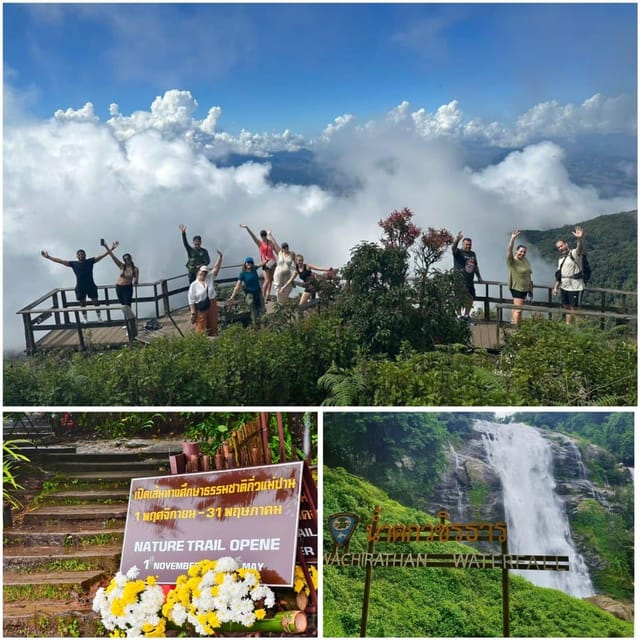
Kew Mae Pan, the ridge trail on Doi Inthanon, is open only from 1 November to 31 May, roughly 6 am to 4 pm, and closed from June through October so the forest can recover. That is five months of the year when a tour title mentioning it is describing something you will not walk. The sign in the picture at the top of this page is the park’s own. Full detail in the Doi Inthanon guide.
The Monk’s Trail up to Wat Pha Lat is washed out and slick in the rainy season from June to October, and local advice is not to walk it then. The temple is still reachable by road. See Doi Suthep and Wat Pha Lat.
Bua Tong, the waterfall you climb, works all year and works differently. The dry months from November to February give the best grip and the most people; from July to October there is far more water coming down the rock, which is more spectacular and harder work, and increases the amount of surface you should not be standing on. See the Bua Tong guide.
Ziplines run year-round but close for thunderstorms, and a booking is not a weather guarantee — the zipline guide covers what that means in practice.
The summit of Doi Inthanon is cold, which regularly surprises people who packed for Thailand and nothing else.
The case for the rainy season, which is better than its reputation
Two things argue for the months most people avoid.
The first is that the landscape is at its best. The Pha Dok Siew trail on the far side of Doi Inthanon runs down past rice terraces to Mae Klang Luang, and the operator’s own description makes the point: the terraces are green in the rainy season, June to September. The months that close Kew Mae Pan are the months that make Pha Dok Siew look its best. The waterfalls across the region are fuller for the same reason.
The second is the air. Rain clears it. The worst air of the year and the wettest months do not overlap at all.
What you give up is reliability. Afternoons are the likeliest time to lose, which is an argument for the early departures that most tours here run anyway.
So, concretely
If you want one answer: November and December, and accept the crowds. Cool, clear, everything open, the trails at their driest, and safely ahead of the smoke.
If you are choosing between February and April, understand that you are choosing inside the burning season and that the later you go, the worse the odds.
If your dates are fixed in the rainy season, you have not lost anything important. Move the walking to the mornings, put the indoor things — a cooking class, the old city temples — where the afternoon rain goes, and expect greener pictures than anyone travelling in March will bring home.
And if you are travelling with children, the month is not a detail — it is the first decision, ahead of the flights. That reasoning is set out in Chiang Mai with children.
Browse what runs year-round on our day trips and Doi Inthanon and waterfalls pages.