Bua Tong, the Waterfall You Climb Up: Getting There and What It Costs
Updated September 30, 2026 · 7 min read
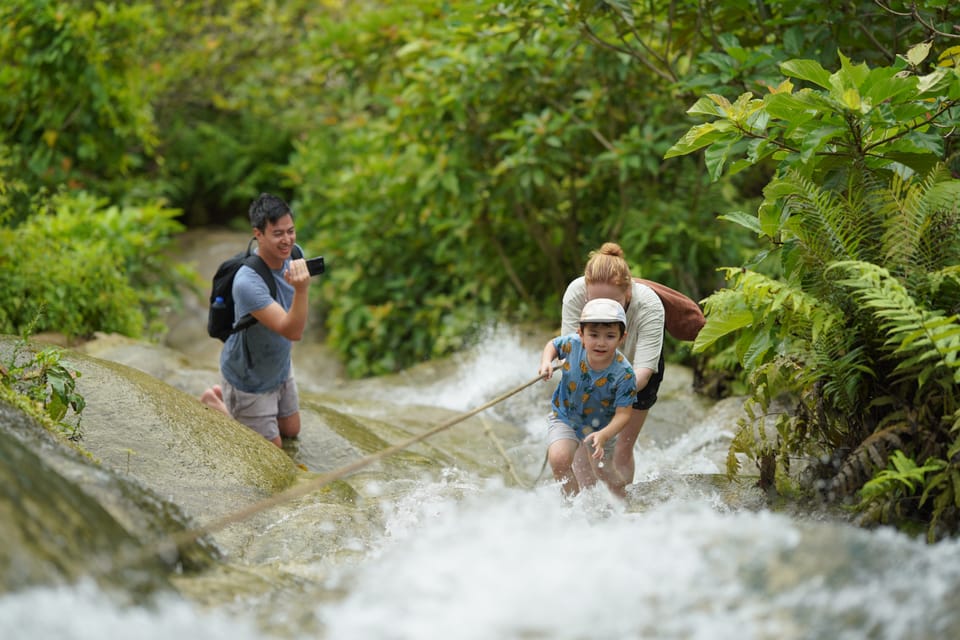
Most waterfalls you look at. This one you walk up, barefoot, against the water, and the rock holds your feet. That is the whole appeal of Bua Tong, and it is the reason it sits in almost every Chiang Mai itinerary despite being an hour out of town in a direction nothing else takes you.
It also costs nothing to enter. What you pay for is getting there.
Why the rock grips – and where it stops
The water at Bua Tong comes out of a mineral spring called Nam Phu Chet Si, a ten to fifteen minute walk above the top of the falls. It is heavily loaded with dissolved calcium carbonate, and as it runs down the slope it deposits that mineral as a rough, porous crust – travertine. The same mineral load is why almost nothing grows on the surface: no moss, no algae, no slick green film.
That is the explanation you will read everywhere, and it matches what your feet report. We could not find a published geological study of this particular site, so treat it as the well-attested account rather than as measured fact.
What matters more is the exception. The pale, chalky rock grips. The dark and greenish patches do not. Where algae has managed to establish itself – in the shade, at the edges, on the steps down – it is as slippery as any wet stone anywhere. Ropes are strung across the steeper sections and people use them. Reports of falls with broken wrists and cut hands are common enough in trip write-ups to take seriously, and there is no official accident record to weigh them against.
So: walk on the white stuff, use the ropes, and treat the descent with the same care as the climb.
Sources disagree on the basics of the place in a way that is worth knowing about. The number of tiers is given as two, three or four; the height as around 100 metres, or 120. And its protected status is genuinely unsettled in writing: some sources describe a Buatong Waterfall–Chet Si Fountain National Park in its own right, carved out of what used to be part of Si Lanna National Park, while others still list the falls as sitting inside Si Lanna. Both versions are in current circulation. It does not change anything at the gate – entry is free either way, you register your name and vehicle, and the site is open 8 am to 5 pm.
Three ways to get there, and they cost very different amounts
Bua Tong is in Mae Taeng district, north of the city. Distances given range from 45 to 60 km depending on where the writer starts measuring; the drive is about an hour to an hour and a half via Route 1001 and a smaller road at the end.
The transfer. The cheapest way there, short of driving yourself, is a van that takes you and brings you back. Three sit close together in the inventory: the Sticky Waterfall hotel transfer at €12.88, 4.5 stars, 489 reviews, 5 hours; the Sticky Waterfall transfer by van at €13.01, 4.5 stars, 791 reviews, 4.5 hours; and the Half-Day Tour to Sticky Waterfall at €16.24, 4.5 stars, 734 reviews, with pick-up at 8 to 8:30 am or 1 to 1:30 pm from the Burger King at Tha Phae Gate.
One honest note about that second one. Its booking page contradicts itself: the inclusions list mentions a guide, and elsewhere on the same page it states plainly that the tour does not include a guide, only an English-speaking driver. We could not resolve which is current. If having a guide matters to you, ask before booking rather than reading the list. The same listing says it is not suitable for wheelchair users, babies under one, or travellers over 70 – those are the operator’s own conditions.
The guided day. The Sticky Waterfall, Land of Angels, Wat Ban Den & Thai Buffet day runs €31.28, 4.8 stars, 1,626 reviews, 8 hours, and includes lunch. The Sticky Waterfall & Angel Waterfall Park Day Tour is €34.17 with 2,782 reviews and the clearest published schedule of the lot: an hour’s drive, an hour and a half at Dantewada, half an hour more driving, then two hours of free time at the falls. Entry to both sites is included; lunch is not.
Look at the ratings across those two groups. The transfers sit at 4.5, the guided days at 4.8 and 4.9. A transfer is a van and a driver; whether that is worth eighteen euros less than a day with lunch and two more stops depends entirely on whether you wanted the other stops.
Your own wheels. A chartered songthaew there and back is commonly quoted at 800 to 1,500 THB and is a matter of negotiation; a car and driver for the day runs to around 1,500 THB from the old city. Scooter hire is cheap – roughly 200 THB a day plus fuel, though we found that figure in only one place.
Before you take the scooter option, one thing is not negotiable. For a motorcycle or moped in Thailand you need an International Driving Permit that covers motorcycles – category A, not just the car category – carried together with your home licence. Checks on tourist routes around Chiang Mai are routine, fines run in the hundreds of baht, and an accident without the right permit can leave your insurance with an easy way out. If you have only the car category, that is not a technicality you can drive around, and comparing car hire for Chiang Mai is the alternative that keeps you legal.
What else is on that road
Almost every guided version stacks two more stops onto the morning, because they are on the same stretch north.
Dan Tewada, sold as the Land of Angels or the Angel Waterfall Park, is a themed garden with constructed grottoes, orchids and an artificial cascade. Entry is 80 THB, free for children under five and for monks and nuns, open 8 am to 6 pm. It photographs extremely well and it is not a natural site – if you have seen a picture of an improbably turquoise waterfall framed by flowering vines and assumed it was Bua Tong, that was Dan Tewada.
Wat Ban Den is a large, ornate temple complex in the same district, free to enter with a donation box, and worth dressing for: modest clothing is expected, as at any working temple.
When to go
The dry months from November to February give the best grip and the most comfortable walking, and they also bring the most people. The rainy season from July to October puts far more water down the rock, which is more spectacular and harder work, and increases the amount of surface you should not be standing on.
The real crowding variable is the day of the week, not the month. Weekends and Thai public holidays fill the site with domestic visitors. On a weekday before 11 am you can have long stretches of it to yourself.
It is not worth the drive in heavy rain, and it is a poor choice if anyone in the group is uneasy on uneven wet ground – there is no viewing platform version of this. You go into the water or you sit and watch other people do it.
For the rest of the waterfall inventory, including the ones on the mountain in the other direction, see Doi Inthanon and waterfall tours – 206 offers from €10.30 – and our guide to the Doi Inthanon day trip, which is the other classic mountain day and needs a much earlier start. Several operators also pair Bua Tong with an elephant camp in one nine-hour day; how to read an elephant camp listing covers what that combination is actually selling.