Elephant Camps near Chiang Mai: How to Read the Listing Before You Book
Updated September 30, 2026 · 7 min read
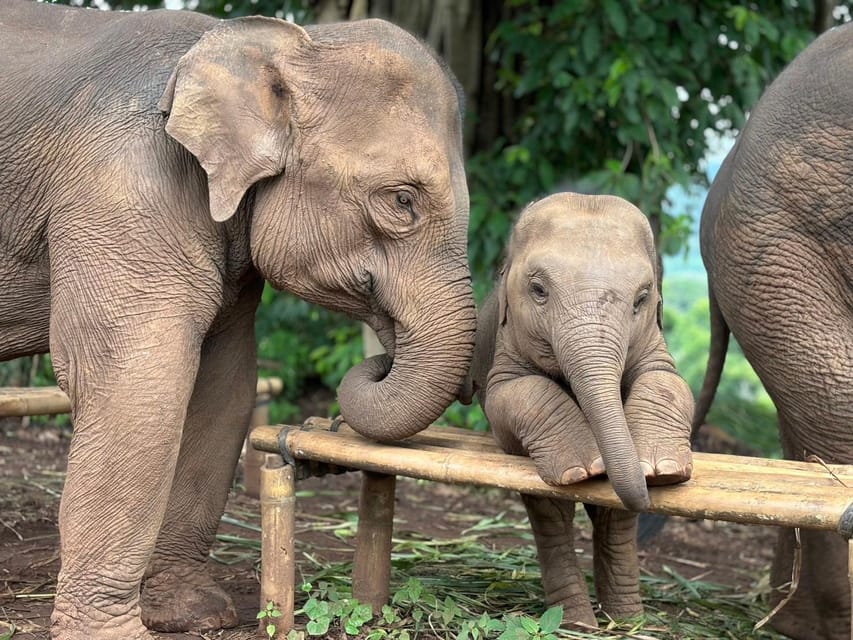
For a lot of people, the elephants are the reason the trip goes to Chiang Mai rather than somewhere else. Our inventory for this city holds 47 elephant offers, from €18.14, with 38,741 reviews between them – the third most-reviewed theme here after the mountains and the temples, and on far fewer offers than either.
Almost every one of them uses the word sanctuary, shelter, rescue or ethical in its title. None of those words is protected in Thailand. No authority checks them, and no licence depends on them. They describe an intention.
That is not a reason to skip the visit. It is a reason to read the listing instead of the name, because the listings differ far more than the names do.
What the word actually rests on
Domesticated elephants in Thailand are not wildlife in the legal sense. They fall under the Draught Animal Act of 1939, the same law that covers cattle and buffalo: an owner registers the animal at the district office and receives a licence for it. The animal is private property. That is why welfare oversight in practice runs through voluntary accreditation – the Asian Captive Elephant Standards scheme is the one you will see named – rather than through wildlife protection law.
So when a camp calls itself a sanctuary, there is no register behind the claim. There may be an accreditation behind it, and that is a question worth asking the operator directly.
The numbers, because they are better than opinions
World Animal Protection published Bred to Entertain on 12 January 2026, an assessment of 236 venues holding 2,849 elephants, surveyed between February 2024 and January 2025. Four findings from it are worth carrying into a booking decision:
- Riding has genuinely collapsed. In 2010, 92% of captive elephants were used for rides. By 2024 it was 43%.
- Conditions have not followed. 69% – a good two in three – were still living in what the report classes as poor or unacceptable conditions, and more than half were kept on short chains during the day. Only 5% lived in the best possible captive conditions.
- More than half were at venues offering washing or care-taking activities – the thing that replaced riding, and the thing most often sold as the ethical option.
- Venues with no contact at all – observation only – held 7.3% of captive elephants in 2024, against 4.6% in 2010.
Read the second and third points together and you have the honest picture: the industry dropped the saddle and kept nearly everything else. World Animal Protection’s position is that bathing is not the gentle alternative to riding, and that the standard worth looking for is watching without touching.
Whether you accept that is your decision, not ours. But you should make it knowing that 7.3% is the size of the option, and that a camp advertising a mud spa is not offering a lesser version of contact. It is offering more of it.
Sorting the offers by how much contact they sell
This is the distinction that actually separates the programmes here, and it is usually visible in the listing text.
Watching, mostly. The Ethical Half Day Elephant Sanctuary & Waterfall – €42.58, 4.9 stars from 728 reviews, 7 hours – describes its day as watching the herd roam, and is the only one in this group whose own description leads with observation rather than with an activity.
A second offer deserves a line here, because it sells exactly what World Animal Protection names as the standard: the Hands-Off Jungle Elephant Tours – €65.71, a full day – puts not touching in the title and describes elephants roaming free in the forest. It has only 19 reviews, so it is not road-tested the way the big camps are, and it costs a good half again more than the observation half-day above. If you want the 7.3% route, this is where it is – just dearer and less convenient than the alternatives.
Feeding and washing. The Elephant Sanctuary Feeding Program Half-Day Tour at Pon Elephant Sanctuary south of the city is the cheapest serious option here: €22.08, 4.9 stars from 6,731 reviews, 5 to 5.5 hours, feeding and washing.
Bathing in the river. The Small Group Ethical Elephant Sanctuary Tour – €63.08, 4.9 stars, 1,594 reviews, 5 hours – is the most expensive of the well-booked elephant half-days and sells the small group as the reason. Bathing is part of it.
Everything, including mud. The Elephant Jungle Sanctuary with Lunch & Transfer – €49.94, 4.8 stars, 727 reviews – lists feeding, bathing and a mud spa. It is the highest-contact programme of the nine we looked at, and it says so plainly, which is more than some do.
The one everybody books is the Elephant Sanctuary, Waterfall & Bamboo Rafting day: €49.68, 4.9 stars, 11,710 reviews – the most-reviewed offer on this entire site – 9 hours, at a camp its own text describes as home to more than 18 rescued elephants. What the booking page includes is unusually complete: hotel pick-up and drop-off if you choose that option, guide, lunch, fruit, drinking water, a towel and tips. It also states a physical requirement that the shorter camps do not: you should be fit enough to walk a kilometre and to get on and off a bamboo raft, and it is not recommended for anyone with severe mobility limitations.
One offer needs flagging for a different reason. The Elephant Sanctuary, Long Neck & Sticky Waterfall day – €52.18, 2,785 reviews – bolts a visit to a “long neck” village onto the elephant morning. The women there are Kayan, they are refugees from Myanmar without Thai citizenship, and the visit raises questions that have nothing to do with elephants. If that combination is not what you want, the camp-only days above cost less and take less time.
Four questions that actually change the answer
- Do the elephants spend the day chained? More than half of the animals counted in the 2026 assessment did. Ask; the answer is specific and checkable on arrival.
- How many visitors per elephant, per session? Nobody publishes this, and we could not find it for any camp near Chiang Mai. Ask the operator before booking – a small-group price usually means exactly this.
- What happens if the elephant walks away? In an observation-led camp, nothing. Where the programme depends on contact, something has to make the contact happen.
- Is there a minimum age? None of the nine listings we read states one, and neither does the booking page of the most-booked tour. If you are travelling with a small child, this is a question for the operator, not an assumption.
Practical things worth knowing
Most of these camps are in Mae Taeng, roughly an hour and a half north of the city; a few, like Pon, are south of it. Half-day programmes run four to five and a half hours including the drive; full days run seven to nine. Bring clothes you can change out of, and expect to be wet if bathing is on the programme.
On anything medical – insect bites, sun, motion sickness on the mountain road – ask a pharmacy or your doctor before you travel. We are not going to recommend a preparation, and no camp listing should either.
If a whole day around elephants is more than you want, the day trips from Chiang Mai category holds shorter combinations, and the waterfall and mountain tours run in the same direction on the same mornings.
Whatever you book, book it as what it is. A camp that lets you wash an elephant is selling contact, not rescue, and the honest ones will tell you that themselves.